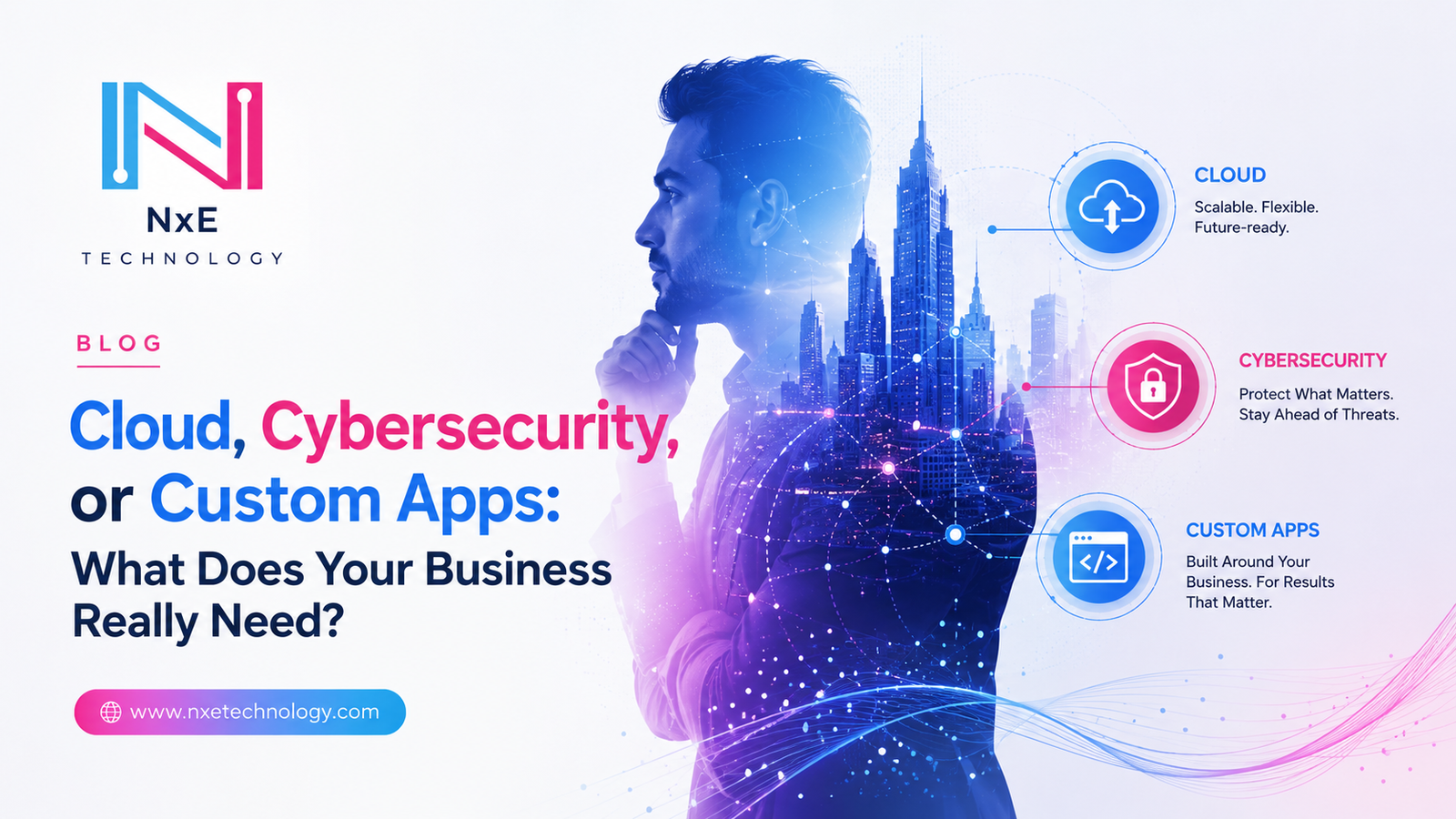
A restaurant owner in Riyadh, a logistics manager in Jeddah, and a fintech founder in Khobar walk into the same problem: they all know they need “IT,” but none of them agree on what that actually means. One thinks the answer is moving everything to the cloud. Another is convinced a cyberattack is the real threat keeping them up at night. A third believes a custom app will finally fix the chaos of spreadsheets and WhatsApp groups running their operations.
Here’s the truth: they’re all partly right — and all partly wrong. Because the real question isn’t “which one do I need?” It’s “what’s actually breaking in my business, and which of these three fixes it?”
At NXE Technology, we get asked this almost every week, from small Saudi businesses scaling fast to established companies trying to keep up with Vision 2030’s digital pace. So let’s break it down honestly — no sales pitch, just a practical way to think about it.
Cloud: The Foundation Most Businesses Don’t Know They’re Missing
Think of the cloud less like a “product” and more like the ground your business stands on. If your team is emailing invoices back and forth, if your point-of-sale system crashes when the internet blinks, or if you can’t check your business numbers while you’re traveling — that’s not a cybersecurity problem or an app problem. That’s a foundation problem.
Example: A retail chain with three branches across Dammam was running each store on its own local system. Every evening, staff manually combined sales reports into one Excel file. Stock mismatches, late reporting, and duplicate orders became routine. Moving their inventory and POS systems to the cloud meant every branch, and the owner, could see real-time numbers from one dashboard — from a phone, from home, from anywhere.
If your business struggles with visibility, remote access, or systems that don’t “talk” to each other across locations, cloud is where you start.
Cybersecurity: The One Nobody Thinks About Until It’s Too Late
This is the one businesses underestimate the most — usually right up until something goes wrong. And in Saudi Arabia specifically, this isn’t just about avoiding hackers anymore. It’s becoming a legal requirement.
Since the Personal Data Protection Law (PDPL), enforced by SDAIA, moved into full active enforcement in late 2024, Saudi businesses — big or small, local or international — that handle customer data are legally required to protect it. SDAIA has already issued dozens of enforcement decisions against companies for weak data practices, unauthorized data sharing, and missing security safeguards, with fines reaching into the millions of riyals. This is no longer a “someday” concern.
Example: A mid-sized healthcare clinic in Jeddah stored patient records on a shared, unencrypted drive, accessible by any staff member’s laptop. It worked fine — until a laptop was misplaced. What could’ve been a minor incident became a data protection liability, because there was no encryption, no access control, and no audit trail showing who touched what. A proper cybersecurity setup — access controls, encrypted storage, activity logs — would have contained the entire issue in minutes, not weeks.
If your business handles customer data, payments, medical records, or anything sensitive, cybersecurity isn’t optional anymore — it’s compliance, and it’s trust.
Custom Apps: When “Good Enough” Software Stops Being Good Enough
Off-the-shelf software is great — until your business outgrows it. Most companies start with generic tools (Excel, generic CRMs, free scheduling apps) because they’re fast and cheap. But at some point, the business starts bending itself to fit the software, instead of the other way around.
Example: A logistics company managing deliveries across Riyadh and the Eastern Province was using a generic fleet-tracking app that didn’t support Arabic invoicing, didn’t sync with their accounting system, and charged per-driver fees that scaled painfully as they grew. A custom-built app solved all three problems at once — Arabic and English invoicing, direct accounting sync, and a flat cost structure that made sense for their growth.
If you’re stitching together five different tools with manual work in between, or paying for features you don’t use while missing the one feature you actually need, that’s your sign a custom solution will pay for itself.
So, Which One Does Your Business Actually Need?
Here’s a simple way to check:
- If your teams can’t see the same numbers, from the same place, at the same time → you have a cloud problem.
- If you’re worried about data leaks, compliance, or “what happens if someone hacks us” → you have a cybersecurity problem.
- If your business is forcing itself to work around software instead of the software working for your business → you have a custom app problem.
Most growing Saudi businesses, honestly, need a mix of all three — just not all at once, and not in the same order. A business handling customer payments should prioritize cybersecurity before anything else. A business expanding to multiple cities should prioritize cloud first. A business drowning in manual processes should look at custom apps before spending more on generic tools.
Why This Matters More in Saudi Arabia Right Now
Vision 2030 isn’t just a government slogan — it’s actively reshaping what “normal” looks like for businesses here. Digital payments are the default. Customers expect apps, not phone calls. And regulators like SDAIA are actively enforcing data protection, not just recommending it. Businesses that treat IT as an afterthought are going to feel that gap more, and sooner, than they expect.
How NXE Technology Helps
We don’t sell one-size-fits-all packages, because your business isn’t one-size-fits-all. At NXE Technology, we start by understanding what’s actually slowing your business down — then we recommend cloud infrastructure, cybersecurity protection, custom app development, or a combination, based on what will genuinely move the needle for you.
If you’re not sure where your business stands, that’s exactly the conversation worth having. Reach out to NXE Technology, and let’s figure out — together — what your business really needs.
Leave a Reply